
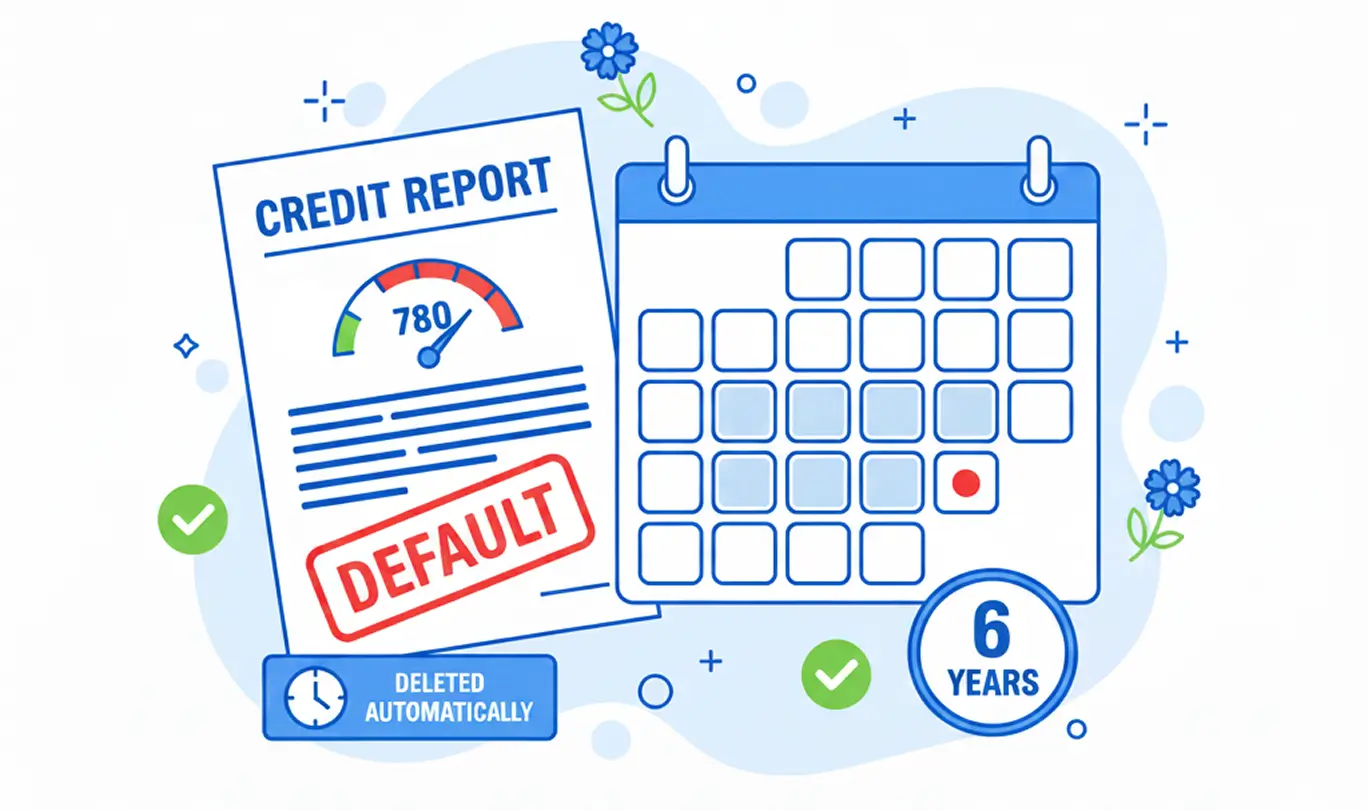
If you've had a setback on your credit file — a missed payment, a default, a CCJ — the first thing most people want to know is when it's going to disappear. The short answer is six years for almost everything, but the detail matters. When the clock starts, what the entry looks like while it's there, and what happens when it finally drops off are all slightly different depending on the type of record.
Here's a clear breakdown of how long each type of negative information stays on your UK credit report, and what it means for your credit file along the way.
The six-year rule, in plain English
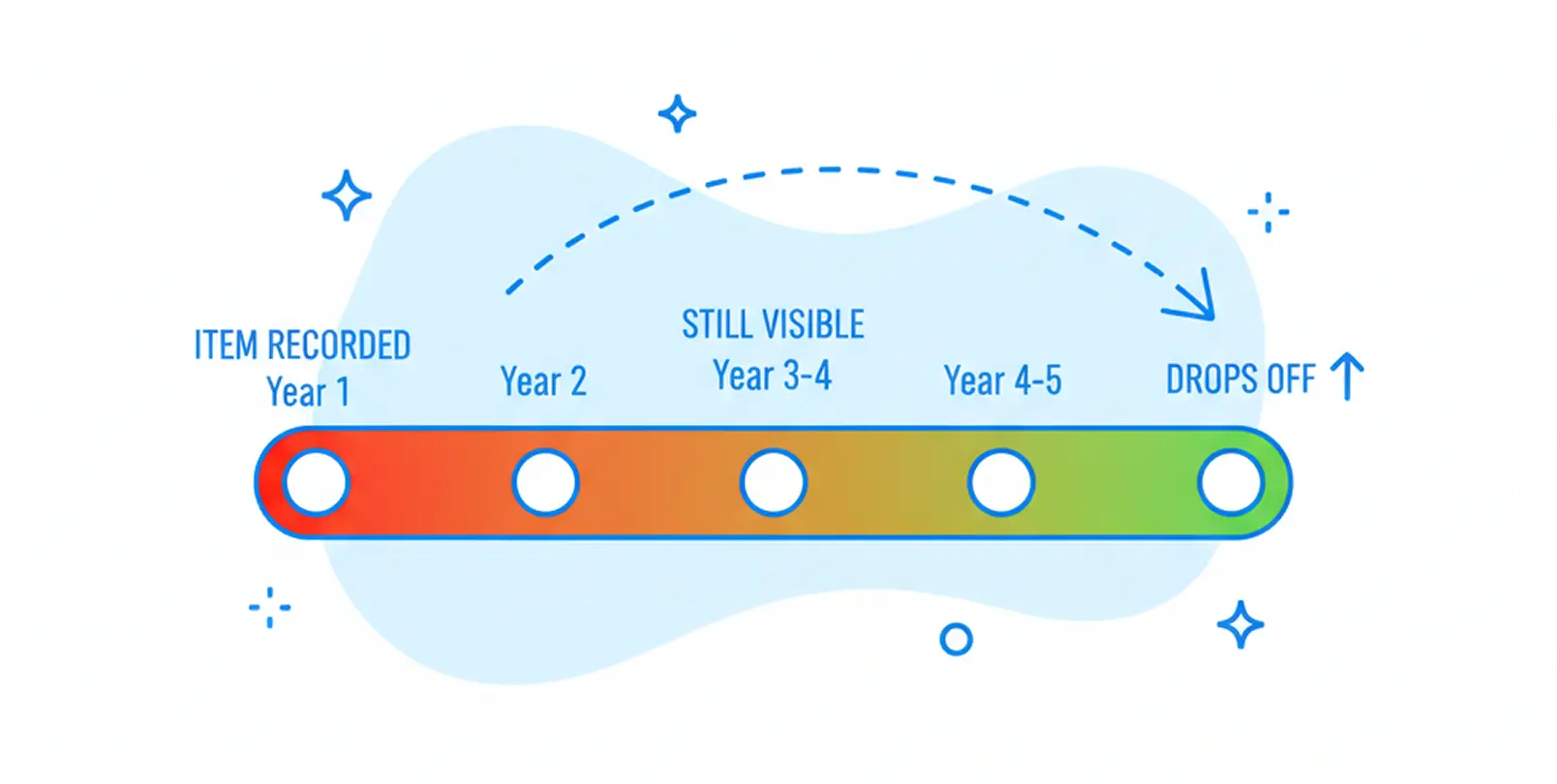
Most negative entries on a UK credit report stay visible for six years from the date they were recorded. This applies whether or not you've paid off the underlying debt. Once the six years are up, the three credit reference agencies (Experian, Equifax, and TransUnion) must remove the entry automatically — in most cases, you don't need to contact them.
What changes during those six years is how the entry looks to lenders. A recent default may have a greater impact than a five-year-old one that's been satisfied, though this varies by lender and scoring model. Lenders don't just see "negative entry, yes or no" — they see the full picture, including how you've handled credit since.
How long does a default stay on your credit report?
Six years from the date of default.
A default is recorded when you've missed several consecutive payments — usually three to six — and the lender formally closes the account as broken. The crucial detail here is that the six-year clock starts from the date of default, not the date you opened the account or the date of the first missed payment.
If you pay the defaulted amount later, the entry stays for the full six years but is marked as "satisfied." A satisfied default may be viewed more favourably by some lenders than an unsatisfied one, though both remain visible until the six-year window closes.
How long does a CCJ stay on your credit report?
Six years from the date of judgment, with one important exception.
A County Court Judgment (CCJ) is a court order confirming you owe money. It's recorded on both your credit file and the public Register of Judgments, Orders and Fines maintained by Registry Trust.
The exception: if you pay a CCJ in full within one calendar month of the judgment date, you can apply to have it removed from the register entirely — it disappears from your credit file rather than being marked as satisfied. You'll need to apply through the court that issued the judgment and pay a small fee.
If you pay outside that one-month window, the CCJ stays for the full six years but is marked as satisfied.
How long do missed payments stay on your credit report?
Six years from the date of each missed payment.
Missed payments are recorded month by month, so each one has its own six-year countdown. A single missed payment from four years ago will drop off two years from now; one from last month will drop off six years from now.
This month-by-month reporting matters if you've had a rough patch followed by recovery. Even if you missed payments in previous years, every month you make on-time payments afterwards builds positive data alongside the negative entries — and each old missed payment falls off on its own anniversary.
How long do IVAs and bankruptcy stay on your credit report?
Typically six years from the start date, although the way it's reported can vary depending on completion timing.
An Individual Voluntary Arrangement (IVA) or bankruptcy stays on your credit file for six years from the date the arrangement or bankruptcy order began. If an IVA lasts longer than six years (they typically run for five to six years), it may remain on your file until it's completed — so in practice, some IVAs are visible for slightly longer than the standard six years.
Both IVAs and bankruptcies also appear on the Individual Insolvency Register, which is a separate public record maintained by the Insolvency Service.
How long do hard searches stay on your credit report?
Twelve months on most reports, though some CRAs show them for up to two years.
A hard credit search (also called a hard footprint) is recorded every time you formally apply for credit. Hard searches are visible to other lenders and can have a short-term impact on your score, particularly if multiple applications are made in a short period.
Unlike the negative entries above, hard searches typically disappear from your credit report after 12 months, though some lenders' scoring models look at up to two years of search history.
Soft searches — including when you check your own credit report — aren't visible to other lenders and don't affect your score at all.
Will my credit score go up when entries drop off?
Often, yes — but not always by a predictable amount, and it can depend on your overall credit profile. When an old default, CCJ, or missed payment drops off your file, the CRA's scoring model no longer sees it, and neither do lenders scoring you from that CRA's data. That can lead to an improvement in your score, depending on everything else on your file.
If the entry that dropped off was the main negative item on an otherwise strong credit history, the improvement can be significant. If there are multiple negative entries, removing just one of them won't change the picture dramatically.
The most reliable way to build your score over time is consistent, on-time payments on active credit accounts — not just waiting for old negative entries to expire.
How to check what's on your credit report
You have a statutory right to a free credit report from each of the three UK credit reference agencies, with no payment details required:
A statutory credit report shows you the raw data each agency holds and is free to request directly — raising a dispute on any errors you find is free too. It won't usually include extras like your credit score, ongoing monitoring, or guided dispute assistance, which is what a paid service adds on top.
If you'd like a consolidated view — your credit score, ongoing monitoring, and guided help to raise disputes on any errors — UK Credit Ratings offers a 14-day trial that covers all three. You can access your statutory credit report for free from each agency, and raising a dispute directly with them doesn't require any paid service.
Start your free trialAfter the 14 day trial, there will be a fee which is applied unless cancelled. At signup you will get to review all the terms. You can cancel your trial at any time during or after via your account or by contacting our support team.
FAQ
Does a default get removed once I pay it?
No. A paid default stays on your credit report for six years from the original date of default, but it's marked as "satisfied." A satisfied default may be viewed more favourably by some lenders than an unsatisfied one, but both remain visible until the six-year window closes.
Can I remove a CCJ if I pay it quickly?
Yes, but only if you pay the full amount within one calendar month of the judgment date. In that case, you can apply to the issuing court to have the CCJ removed from the register entirely. Outside that window, a paid CCJ stays on your file for six years, marked as satisfied.
Do missed payments disappear one by one or all at once?
One by one. Each missed payment has its own six-year countdown from the date it was recorded. So if you missed payments across several months, the oldest ones drop off first, with later ones following on their own anniversaries.
Why is there a six-year rule in the first place?
UK data protection rules require credit reference agencies to keep records that give a fair and accurate picture of how you've managed credit, without keeping them indefinitely. Six years is considered long enough for lenders to make informed decisions while still giving people a route back to a clean credit file over time.
How do I know what's on my credit report right now?
You can request a free statutory credit report directly from Experian, Equifax, or TransUnion. This shows you exactly what each agency holds about you, including the dates each entry was recorded — which tells you when each one is due to drop off.
Learn more about whether you can remove negative information from your credit report and how to spot errors on your credit report. For a full overview of your options, visit our guide to Disputing Errors on Your Credit Report.